



 Staff Writer
 Working out how often cannabis plants should be watered can be a perplexing chore; There exists a whole slew of diverse variables to consider if we are going to get this right.
So we’re going to embrace some basic points below to get you started on your quest for the perfectly watered cannabis plant!
I guess you may be wondering by now, and if not, I thought I’d get this out the way early in this post anyway:
There Is No General Answer To “How Often” Cannabis Plants Should Be Watered
Regrettably, there simply is no golden rule here for cannabis plant hydration, and the reason for that is somewhat simple: Too many variables to consider for an accurate evaluation!
Some of the chief factors that need to be evaluated are below:
Cannabis Plant Age
The age of your cannabis plant can be a prominent determinant when it comes to deciding how much water it should get, and how often. Mature plants favour more frequent watering whereas younger plants would need less.
Cannabis Plant Life Cycle Stage (Not The Same As Age!)
Taking note of your cannabis plant’s life cycle stage is also of paramount importance, as it too factors in when deciding on a watering schedule. Vegetating plants need less water when contrasted with flowering cannabis plants.
Remember, this isn’t the same characteristic as noting the “age” of your cannabis plant. In certain setups, plants can be kept in a vegetive state indefinitely, and there is also the assumption that not all growers plant their seeds at the very beginning of “growing season”.
Cannabis Plant Root Ball Size
As troublesome as this one is to visually comprehend, one can’t simply deny that the size of a cannabis plant’s respective “root ball” has an influence over how much it should be watered, and how often; Lest one wishes to run into problems down the line!
Cannabis Plant Container Size
This should be an apparent constituent, nevertheless, you’d be astonished at just how often the volume of the containers/pots or flowerbeds are overlooked when it comes to deciding on a watering agenda.
If you finding yourself having one of those “ohhh shitt…” moments right about now, don’t feel bad! It’s all good, now that you have it in mind 🙂
Soil Mix
The last of our key contributing factors for preparing a suitable cannabis plant watering schedule is a rather consequential one. First of all, soil tends to vary widely in composition from grow to grow and each grower out there seems to have a different recipe for the best “soil mix”…
The composition of your soil accompanying what it is mixed with shall determine the “rate of drainage”. Setups with poor drainage will require less water than systems that drain efficiently.
Figuring Out How Often Each Cannabis Plant Should Be Watered
This is certainly the keystone of this post, and I am convinced that you are just waiting to burn through it all so that you can go tend to you ladies!
I do advise you, however, to keep reading on to the end, as some of the most common issues related to his topic are listed ahead…
Assess Each Cannabis Plant Individually
You must assess each cannabis plant individually since it is likely that each setup is different; Unless you have a pristine commercial operation going on, then I suggest that you take this advice to heart!
I advise tackling some of the more obvious factors first, so, let’s take a look…
Cannabis Plant Age
As discussed earlier in this post, the age of your cannabis plant makes a meaningful difference to the frequency and volumes in which you should be watering. In ideal growing conditions, the older a cannabis plant gets, the larger its mass becomes, which in turn requires more water!
Age does not necessarily associate with the size of cannabis plants, however, for the sake of keeping this post simple, I’ve decided to focus more on plants that are not being “bonsai’d” due to weird growing setups or poor conditions (a lack of nutrients and/or available sunshine).
With all that stated, younger (smaller) cannabis plants require less water, less often than older (larger) more established cannabis plants.
Nuggie Tip: Keep your seedlings in smaller containers, housed within a humidity dome, or “propagation chamber”, for all you who are waiting to scold me in the comments 😉 – these containers can be built out of a bunch of household items; I have found many generic disposable containers to be fairly practical for the purpose, especially the tubs that you get veggies in 🙂
Cannabis Plant Life Cycle Stage (Not The Same As Age!)
The distinct stage in you’re cannabis plant’s life cycle can play a leading role in determining your watering schedule. Each “stage” has its own individual set of ideal environmental influences, including how much water is needed and in what frequency it should be delivered.
Cannabis Seedlings
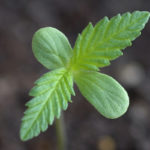
Beginning at the beginning; Cannabis seedlings require little water, but in high frequencies. Essentially, you want the soil (or another medium) to stay moist, however, too much water has the potential to cause root rot or even to drown your seedlings!
On the other hand, allowing your soil to dry out whilst attempting to propagate cannabis seedlings is a huge and often fatal mistake.
If you had previously soaked your soil before planting, then theoretically, you should only need to water your seedlings every second day or so with a “misting bottle”. Be sure to keep an eye on your soil and make sure it does not show signs of drying out or over-watering.
Cannabis Plants In Vegetative State
Cannabis plants in their vegetative state are relatively low maintenance when it comes to figuring out a solid watering schedule. They are most resistant to issues in this particular stage of their life cycle and tend to be forgiving when it comes to over/under-watering, however, there are limits!
Depending on its size, a vegetating cannabis plant would be okay to water every other day (2 – 3 days apart) – keeping in mind that a good rule of thumb here is to wait until the top layer of soil is dry.
Remember, you just want to see the topsoil dry out, not lower, otherwise, you might dry/stress out your cannabis plant’s root system. If you water too often, then you run the obvious risk of overwatering your cannabis plants.
Flowering Cannabis Plants
Flowering cannabis plants typically demand significantly larger volumes of water than would be suitable during the other stages of their life cycle. This is when the plants need to circulate more nutrients through their vascular networks, which is where larger volumes of water become beneficial. More nutrition for your nuggies!
More diminutive plants like autoflowering varieties would have less of an impact on your watering schedule given their average mass is (usually) considerably less than that of a regular/feminised cannabis plant.
It is not uncommon for growers to give their well established flowering plants a full soak daily, however, one must always be wary of over-watering! If in doubt, keep an eye on the top-soil and wait for it to dry out a bit before the next watering session.
Cannabis Plant Root Ball Size
I feel that this is an intuitive sub-topic; A more established cannabis plant root system would intake higher volumes of water. The issue is, how do we figure out how large the root ball for any given cannabis plant is?
This is difficult to figure out. Most grow setups have the roots of the plant/s completely hidden from view, keeping the roots safe from exposure to light, by design.
Unless you are running a particular type of soil-less growing system, like aeroponics or hydroponics for example, then I am afraid that you will have to rely on information that has been documented about the strain you have planted… Time to get your Google on!
Cannabis Plant Container Size
This is a pretty big deal when it comes to concluding how much water should be given to your cannabis plants, and how often. Larger flower beds serve to hold more water for shorter periods, whereas smaller pots will hold lower volumes for longer periods.
The drainage aptitude of any given container also factors in largely when it comes to working out your watering schedule. Some setups have poor drainage (few to no holes) which is especially common with smaller ones, meaning watering must be undertaken less frequently. Larger containers or flower beds tend to have superior drainage by design, and therefore require more frequent watering.
Soil Mix
Your grade of soil as-well-as the mixture of components can affect a tremendous difference to drainage efficiency and water retention. Every grower seems to have their idea of what the perfect soil recipe/mix is, which makes giving advise on it especially challenging.
No Soil Mix (pure soil)
If you have not created a soil mix (you just dug a hole in the floor, or emptied a bag of commercial soil into a container), then I would advise that you do so, as it will certainly benefit the overall health of your plants.
With that declared, pure soil (without other additives) does not drain as efficiently nor does it retain water as well as a more reliable mix would. In this case, you must be careful not to over-water your plants! Try keeping eye on the top-soil and wait for it to dry out before your next watering session.
Don’t water too quickly, it is best to water in smaller doses, allowing the water from the initial batch to drain into the soil completely before continuing with the next batch. You want to avoid creating a micro flood in your pot! Think of all the little soil critters down there, keeping your garden tidy 😉
With Soil Mix (items added to increase water retention and drainage efficiency)
If you have gone down the road of properly preparing your soil, then good on you! I am sure that your ladies are especially happy that you decided to go the extra mile for them 🙂
That said, you should keep in mind that the whole idea of the soil mix is to manipulate the way water interacts with the substrate. Check out your recipe, and take a look at the components of the mixture. Isolate each component and do a quick Google to find out how it would affect watering times.
Good soil mixtures generally afford growers some wiggle-room in their watering schedules, so, it is not necessary to get draconian about your process. Just try to keep in mind that different mixtures in different containers can make things more confusing and also challenging to automate.
Having a “standard soil mix” that you use ubiquitously throughout your grow, or going down the route of soil-less growing can help significantly when it comes to working out a solid watering schedule.
Remember the little rhyme: When in doubt, wait for the top-soil to dry out…
Soil-less Setup
If you have decided go for a “soil-less” setup, then I have to take a moment to tip my hat to you; Don’t get me wrong, I fully respect soil grows, and I understand that there are tons of benefits to growing in good ol’ dirt…
Nevertheless, we can’t deny that it demands a certain measure of motivation to get a soil-less grow operation established and properly configured, and I appreciate that moxie!
If this is indeed your situation, then I presume that you have read up on the numerous “pro’s & cons” associated with your distinct configuration/setup. If not, well, this is a pretty good time to give that a go!
Every design has a different vibe when it comes to water distribution, here are a few common attributes to consider:
- Drainage efficiency of the system.
- Water retention capabilities of the substrate used.
- The volume of water released/pumped/introduced per hour.
Keep in mind that the short-list above is mention of just a few common attributes; There are indeed many more. You are encouraged to research your setup extensively in-order-to determine a good watering schedule.
Keep Your Schedules Up To Date
Remember, there is no golden rule for how often cannabis plants should be watered; Even if you have figured out the perfect schedule, for now, you should nevertheless consider that your cannabis plants will grow over time and advance through their respective life cycle stages.
The obvious take from this advice is that your cannabis plant’s individual needs will shift over time, so update your watering schedule accordingly.
Think of this as more of a watering “model”, rather than a watering “schedule”…
Possible Issues Ahead
If responsibility is not taken to figure out how much cannabis plants should be watered, then there are two fundamental problems that a grower may face…
Note: These are merely two of the central issues, not considering the surplus of related concerns that usually accompany them.
Over-watering
As the name implies, this is when cannabis plants receive too much water, causing a plethora of issues such as root rot, stunting root growth, starving roots of oxygen (drowning your plant), and much more.
This is certainly as severe as it sounds and should be diligently avoided whenever possible.
Common ways to detect signs of over-watering in cannabis plants are:
- Drooping or curling of the leaves is usually the first sign.
- Wilting of the plant stem would soon follow the above symptom.
- Browning on the tips of leaves.
- Fat or “Swollen” leaves.
- Discolouration of the leaves, which may betoken a variety of nutrient deficiencies, induced by over-watering.
Under-watering
Again, this sub-topic is reasonably instinctive; A lack of water will ultimately prove to be problematic for cannabis plants, essentially leading to the death of the plant if not reformed in time.
As alluring as it may be to permit the substrate to dry out for long enough to influence faster root growth, there must be a balance!
Common ways for detecting under-watering in cannabis plants are:
- As confusing as it may be, the number one manifestation of under-watering is pretty much the same as the first symptom for over-watering – Drooping of the leaves!
- The leaves will begin to feel “paper-like”, which is the opposite of what you’d expect from over-watering (fat/swollen leaves).
- Over time, the leaves will begin to turn yellow, indicating distinct signs of nutrient deficiencies, prompted by under-watering.
There are many more signs related to both over-watering and under-watering cannabis plants, but again, that topic would be best expressed in a separate post. Don’t worry fellow nuggies, we’ll get there 🙂
If you’d like to bestow your knowledge unto the Nuggiehub community, don’t hold back! We are openly accepting articles and posts for moderation and publishing! We welcome and look forward to your contributions!




GIPHY App Key not set. Please check settings